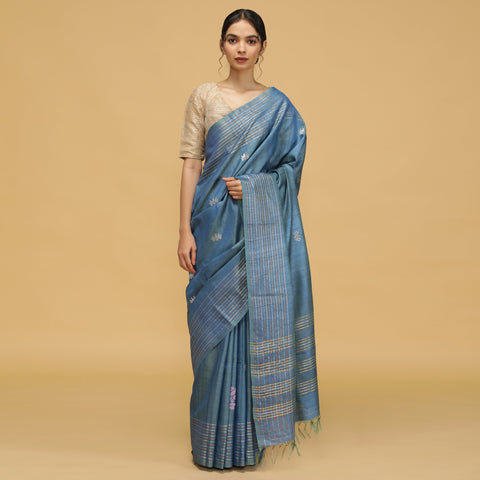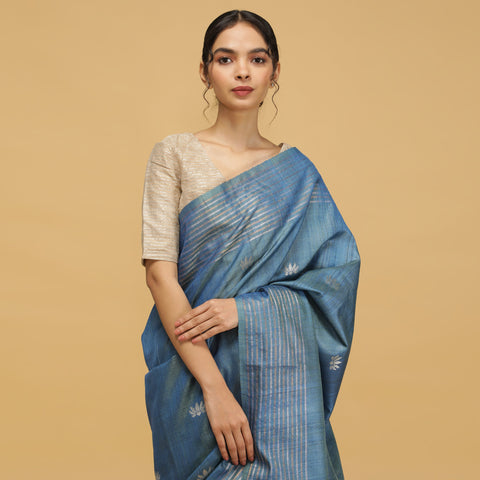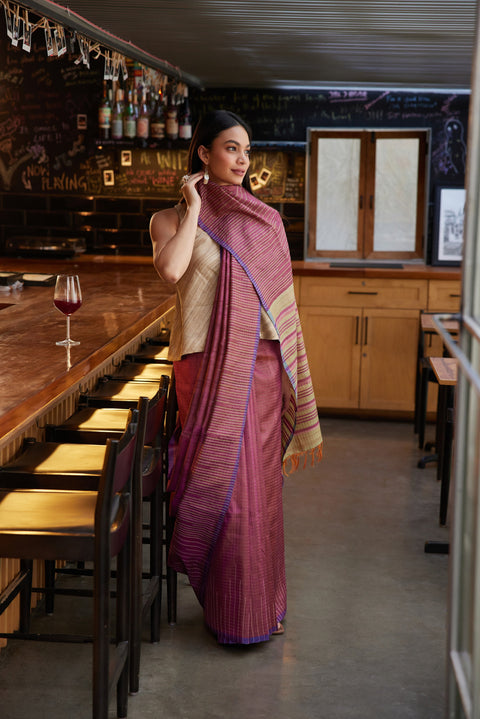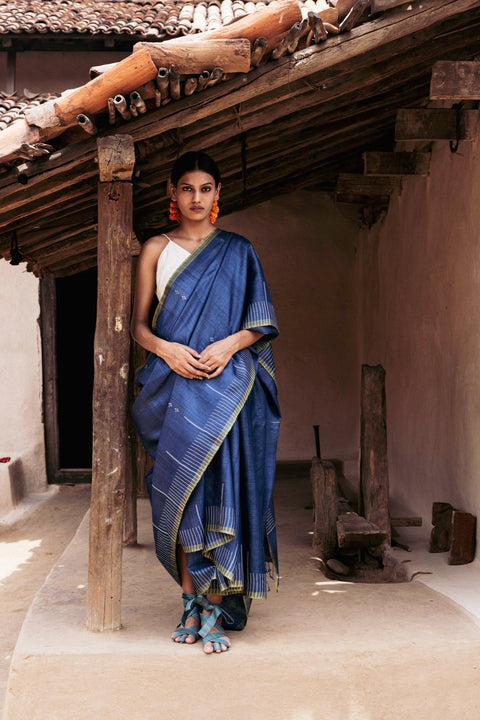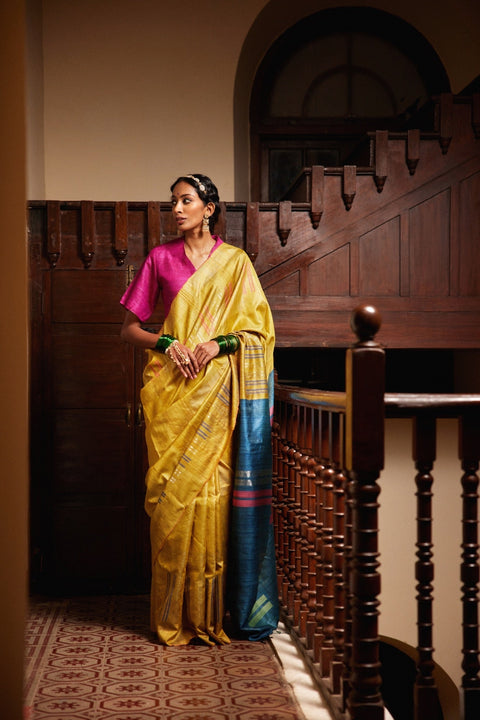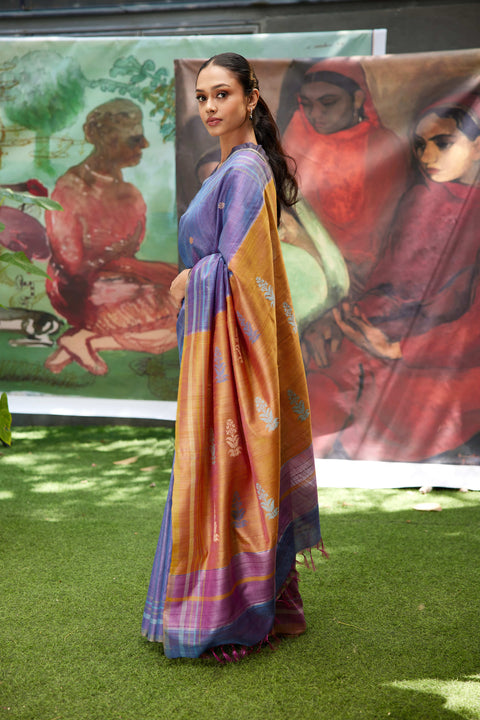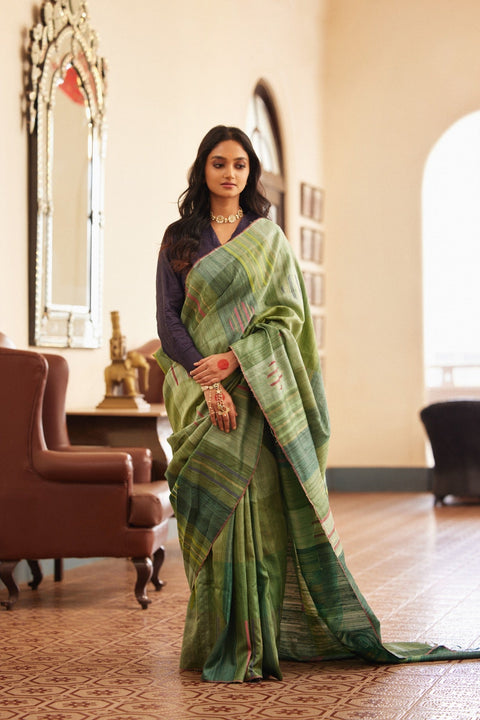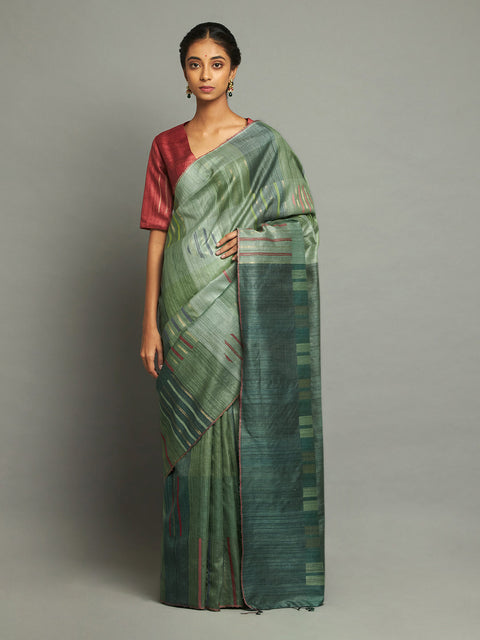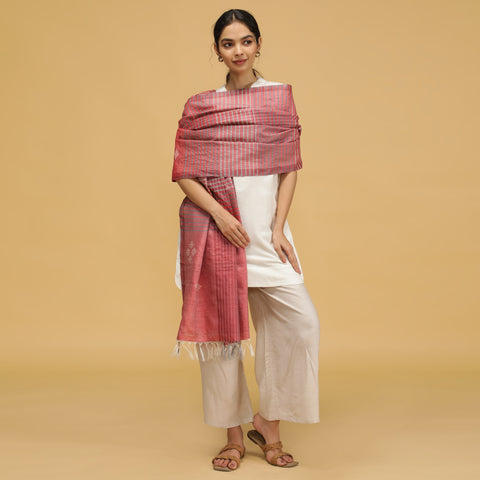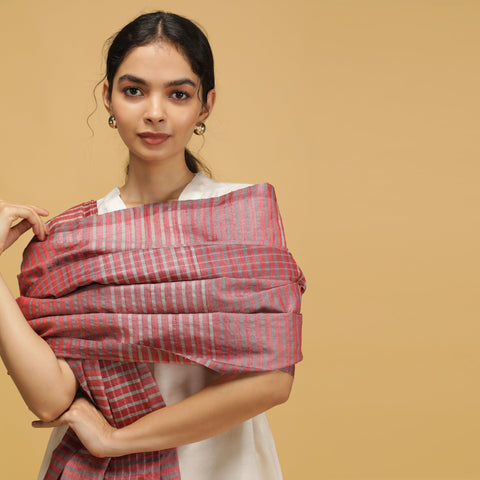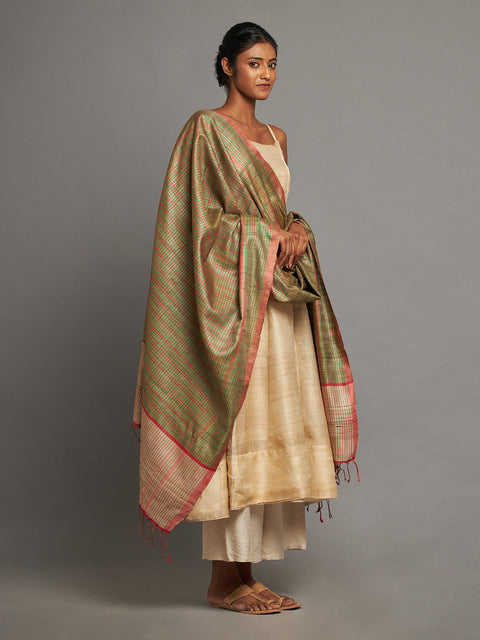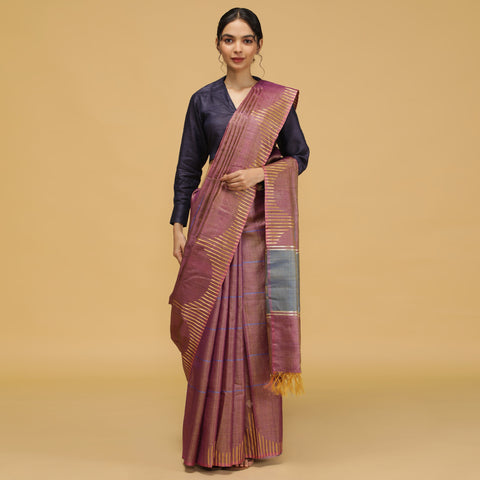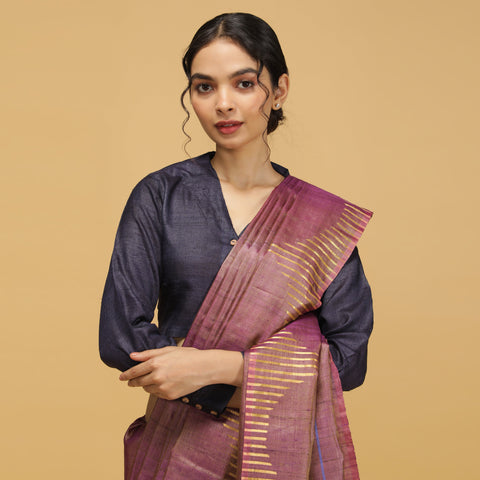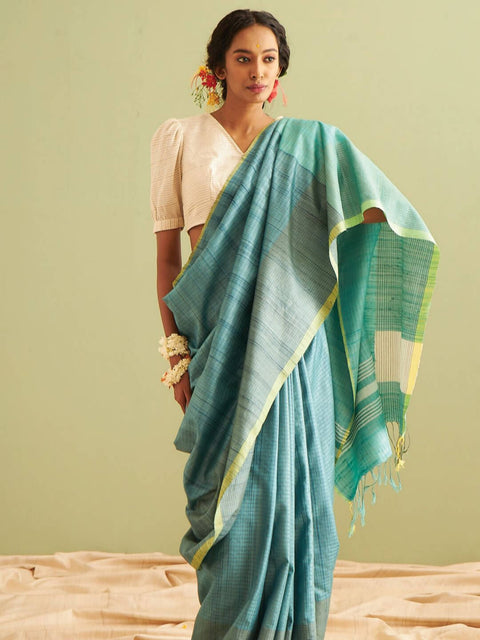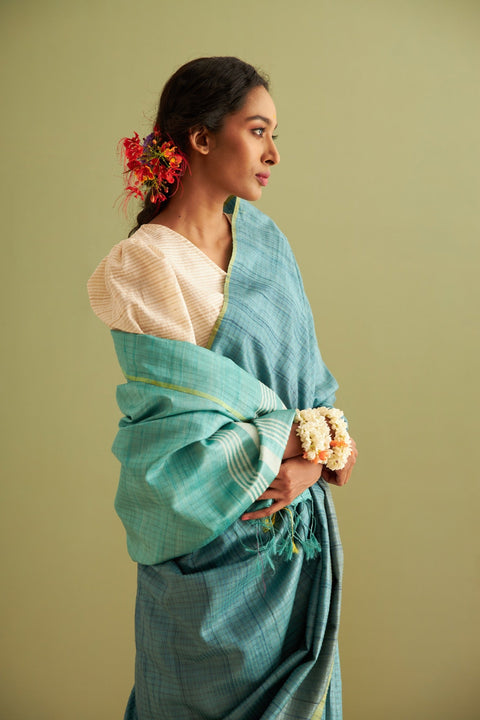


Most saree guides stop at the pallu, then leave the dupatta as an afterthought: "just drape it on top." But once the saree is already pinned and pleated, where does a second piece of fabric actually go?
Quick answer: In saree draping with dupatta, the dupatta goes on after the saree is fully draped, pinned at the blouse strap (not the fabric), in a weight that matches your saree. Below is the full breakdown, plus a 7-step walkthrough.
If you're not sure a dupatta is even the right layer for your outfit, a stole vs. dupatta comparison helps to decide on which to go with in connection to your outfit.
How to Drape a Dupatta Over a Saree, Step by Step
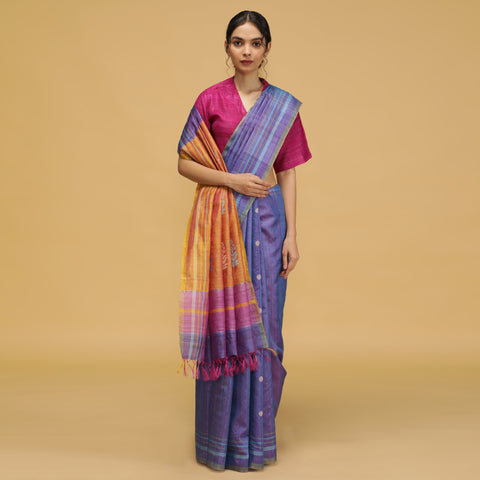
This is saree draping with a dupatta in practice: the matching shoulder layer, which is the easiest version to start with. For the opposite-shoulder cross drape, follow Steps 1-2, then cross to the other side in Step 3.
Finish your saree first: Pleat, tuck, and pin the pallu as you normally would.
Find the dupatta's midpoint: Hold both ends and let it fall in half, so you know how much fabric sits on each side before you start.
Place it over the same shoulder as your pallu: Let it follow the pallu's line rather than crossing over it.
Pin it at the blouse strap: Slide the pin through the inner shoulder seam and catch a small fold of the dupatta.
Add a second pin near the collarbone if the fabric is heavy, to stop it swinging forward when you sit or bend.
Adjust the length: Let the dupatta sit shorter or longer than the pallu, not the same length.
Check the front in a mirror: If the dupatta is pulling the pallu's pleats sideways, loosen the pin and re-anchor slightly higher.
The 3 Things That Actually Matter
Everything in saree draping with dupatta comes back to these three decisions:
Decision
The rule
Where it goes
Same shoulder as the pallu (easiest), or crossed from the opposite shoulder (more structured)
Where you pin it
The blouse strap, never the loose saree fabric
Fabric weight
Match the dupatta's weight to the saree's
If you only remember one thing, remember the pin placement. It's the single biggest reason dupattas slip.
Where Does the Dupatta Go on an Already-Draped Saree?
Always drape the dupatta second, once the saree is fully pleated and the pallu is pinned. Doing both at once means one of them shifts while you work on the other.
Two placement options:
1. Matching-shoulder layering The dupatta sits over the same shoulder as the pallu, following its line. The two fall together as one drape. This is the easier, more forgiving option.
2. Opposite-shoulder cross drape The dupatta crosses from the other shoulder, creating a diagonal line across the front. Works best with a plain or lightly worked pallu, since it gives the dupatta room to stand out as its own layer.
How to Pin It So It Doesn't Slip
Slipping comes down to one thing: what you're pinning to.
Pin the dupatta to the pallu fabric, and both layers just shift together all day. Pin it to something fixed, and it stays put.
Pin through the inner shoulder seam of the blouse
Anchor to the blouse strap, it doesn't move when you walk or sit
Add a second, smaller pin near the collarbone if the dupatta is heavy
Don't pin fabric to fabric
One pin on the blouse strap beats three pins along the edge.
Which Fabric Pairing Actually Works
Fabric pairing is where most saree draping with dupatta attempts fall apart. The saree and dupatta don't need to match in fabric. They need to match in weight. A heavy dupatta over a soft silk saree drags at the shoulder and pulls the pallu's pleats loose by evening.
This holds whether you're draping a Kosa silk saree or working with textured weaves like tussar silk sarees, which carry their own distinct drape and stiffness.
Your saree
Go with
Watch out for
Kosa silk
Lightweight chiffon/georgette, or matching Kosa silk
A heavier dupatta can pull the pallu's pleats loose over time
Cotton / cotton-silk
Light cotton, mul, or georgette
A silk dupatta feels disproportionately heavy and stiff
Structured silk (Kanjivaram, Banarasi)
Matching structured silk, including handloom silk sarees that carry a similar weight and body
A very lightweight dupatta looks thin against a heavily worked saree
A Kosa silk saree with a matching Kosa silk dupatta for lehenga creates one continuous drape, useful when you want the dupatta to read as part of the saree, not a separate layer.
Single Dupatta or Double Dupatta?
Single
Double
What it is
One dupatta, layered over the pallu
Two dupattas, one at the head/pallu-style, one at the shoulder
Best for
Most festive occasions
Bridal looks specifically
Effort
Minimal pinning
Both pieces need to stay light enough together to avoid straining the shoulder seam
For the double-dupatta look, a bridal dupatta paired with a wedding silk saree gives you two pieces built for the same occasion and weight range.
Common Dupatta-on-Saree Mistakes to Fix
Most mistakes in saree draping with dupatta come down to the same three issues, repeated across different sarees and occasions.
Bulk at the waist: happens when the dupatta is tucked in at the same point as the saree pleats. Tuck it slightly to the side instead, so the two layers don't compete for the same spot
Competing pallu and dupatta ends: if both ends hang at roughly the same length, they visually merge into one messy edge. Let the dupatta sit a little shorter or longer than the pallu so each is distinct
Uneven length: a dupatta that's noticeably shorter on one side usually means it wasn't centered before draping; find the midpoint of the dupatta before you start, not after
What Makes the Rest Easy
None of saree draping with dupatta is about mastering more styles. Pin placement, fabric weight, and where the dupatta sits against the pallu get those three right, and the draping itself takes a few minutes. Everything else is just refinement.
Once the pinning and weight-matching no longer require conscious thought, two things are worth exploring next: this 10-minute saree draping guide for the base drape this one builds on, and this dupatta draping styles guide for the belted, cape, and cowl variations, once the fundamentals are second nature.
Dupatta draping over a saree isn't a separate skill from saree draping itself, it's an extension of it. Once you know where the dupatta goes, how to pin it so it holds, and how to match its weight to the saree underneath, the look stops depending on trial and error and starts being something you can repeat every time.
Frequently Asked Questions about Saree Draping with Dupatta
Q: Do you need a dupatta with a saree, or is it optional?
A dupatta is optional with a saree, since the pallu already serves a similar visual role. It's typically added for extra festive weight or ceremony-specific looks like double-dupatta bridal drapes.
Q: Can you wear a dupatta over any saree drape?
Most drapes can take a dupatta, but the fabric weight needs to be considered first. A heavy dupatta over a soft, lightweight saree drape can pull the pleats out of shape.
Q: How do you stop a dupatta from slipping off the shoulder?
Pin it to the blouse strap rather than the saree fabric itself. The strap holds its position through movement, while pinning to loose fabric lets both layers shift together.
Q: What's the easiest dupatta drape for a beginner?
The matching-shoulder layer, where the dupatta follows the same line as the pallu, is the easiest starting point. It needs minimal pinning and doesn't require managing a second, separate silhouette.
Q: Should the dupatta match the saree exactly?
No, matching in weight matters more than matching in fabric or color. A Kosala Kosa silk dupatta paired with a Kosa silk saree gives a cohesive drape, but a contrasting lightweight dupatta works just as well if the weights are compatible.
Learn More